
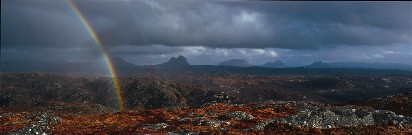
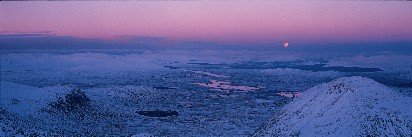
Moonrise
Photographer Colin Prior, who took this photograph says: I am fascinated by the fleeting nature of the optical phenomena I observe outdoors, such as rainbows, the Aurora borealis (northern lights) or an eclipse.
unique photographic challenges and for a photographer, require an
understanding of the factors, which create them.
unexpected places such as waterfalls or geysers. At the beach we can see ‘surf bows’ and there is a ‘marine bow’ formed from the prow of a ship. Whether it is formed in the spray from your garden hose held at arms length, or in a sheet of rain a few miles away, the angular size of a bow remains the same.
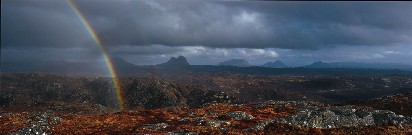
Glencanisp
In the image of Glencanisp in Sutherland, squally showers were blowing in on a north-westerly air stream across this ancient landscape – the weathered towers of Canisp, Suilven, and Stac Pollaidh are composed of Lewisian Gneiss some 300 million years old and are surrounded by a sea of Torridonian sandstone, somewhat younger at 100 million years old. It was an early April evening and the sun had begun to set. As this heavy squall began to pass I
recognised the potential for a rainbow to form and in anticipation, set up my tripod as it still poured. Within minutes the sun had broken through and was illuminating the tail end of the shower forming both and primary and secondary arcs – the primary one being the most vibrantly coloured. I managed to photograph four 6×17 frames on my panoramic camera before it faded as quickly as it had appeared.
about as rare as Unicorns!
Frustratingly, the sun was setting further north than I had anticipated and
I turned my attention in the other direction towards Ben Dorain and the
Crianlarich Group. As twilight approached, the drama intensified and I shot
a series of images as the shadows began to engulf the mountains – such was
the success of the shoot that I chose one of the images for the front cover
of Scotland – The Wild Places.
solely focussed on descending, however, I remembered that a full moon was
forecast that evening and I lingered on the summit in the gloaming to see
where it might rise. Within fifteen minutes a purple sphere was rising over
the Rannoch Moor, through the earth shadow and into the antitwilight arch.
It was a phenomenal scene and I shot a dozen frames on the Fuji GX617
panoramic fitted with a 180mm lens.
or aircraft) when the sky is clear and there is a long line of sight. For a shadow to be visible it must be cast upon something and in this case it is cast upon the atmosphere itself. As the sun sets, the boundary between the earth shadow and the antitwilight arc rises in the sky and becomes progressively less distinct.
where the centre is correctly exposed but the edges of the frame are considerably darkened. With transparency films, bracketing is the best way to ensure the optimum result and those photographers working with digital cameras should consider RAW capture, to give as much flexibility to replicating the image which was directly observed at that moment.