

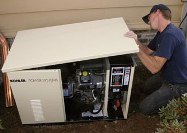
Living off the grid, generators have a place. There comes a time when some backup power is needed. In most cases this means using an engine to turn some form of generator.
People living in Vans, camping trailers or small cabins tend to view a seperate engine driven generator as a nuisance to be tolerated and usually do not wish to spend much money. Various alternatives present themselves.
Running the Van motor to charge up the battery is among the first solutions that comes to mind. Next is a small stand alone portable genset and a typical automotive charger that plugs into the mains.
Clever DIY persons who are handy with tools have even rigged up utility or lawnmover engines with a surplus belt driven automotive alternator and that is about as far as it goes. Few people delve into the subject beyound this point.
In the boating field much greater engineering effort has been made because an anchored boat is also off-grid and must rely on the same power sources as an off-grid home ashore. Off-grid people can benefit by borrowing a few ideas from this.
First and foremost there is the problem of noise. This is easy to solve with good mufflers and sound absorbing enclosures. It does cost money but it can be done by you if you are handy with tools.
Second is the concern over burning fossil fuels. People who want to get off-grid also have a heightened awareness of ecological impacts and environmental issues.
When running a fossil fuelled generator, getting the most watts from the least amount of fuel burned should be a priority . This article will deal with this last issue.
Conventional generators run at a constant speed regardless of how big the load is. If you are not using the full output from the genset, it is not as efficient as when it is loaded to its full rated output.
About the smallest generator you see nowadays is 1 kilowatt. Honda used to make an 800 watt model but it did not sell enough to justify continuing production.
One kilowatt calculates into 70 amps charging current for a 12 V battery which is a pretty substantial sized charger. Most people tend to get a much smaller charger. Quite often an automotive type that deliver 10 or 20 amps at most. 20 amps at 14.2 V amounts to only 284 watts or 28 percent of the rated output from a 1000 watt generator.
A characteristic of constant voltage chargers is the fact output current steadily decreases as the battery voltage increases.
Prudent people begin to recharge long before the battery is totally flat. When using a constant voltage charger, this means the charger is putting out even less than the possible maximum and now the genset has to run for a longer period of time burning more fuel and creating more pollution.
So what is the answer you may ask?
Honda EU2000 offers one smart solution. The Generator can vary the speed according to the load. Light load = slow speed= less fuel burn and less pollution.
Another solution is the ‘smart’ charger often found used on boats.
A smart charger uses a microprosessor to adjust the output constantly for best results. During the first stage the output is held to a constant full current value until the battery reaches about 75% of full charge. At that point the output is changed to constant voltage and the charge current tapers off as the battery voltage rises up to a maximum. A third stage consist of a float voltage that finishes up the charge to reverse all of the lead sulfate back into lead and sulphuric acid. These smart chargers are also called 3 stage chargers. In recent years four stage chargers have also emerged on the market.
Current capacities range from 10 amps to as much as 100 amps.
An automotive alternator used to charge the car battery is a fixed voltage type and amounts to a terrible waste of engine power because so much of the time is spent putting out less than the maximum possible. Not only that, except with very small motors, the load placed on such an engine is so light the engine never warms up properly and is even more polluting , not to mention inefficient in fuel consumption. Idling a car engine does not spin the alternator fast enough.
To make the most efficient use of engine driven generators and alternators; the charging in watts should equal at least 70% of the watts output produced by the internal combustion engine.
And this output current must be adjusted to the size of the battery bank to avoid damage to the battery.
In all the articles, websites, and even product offerings by companies catering to the off-grid market I have not seen any indication this is being given consideration.
Starting up a van and letting the engine idle (even a fast idle) to charge a battery is probably the most inefficient method.
Running an over sized portable genset with an undersized charger is better but still pretty inefficient.
Getting something that is really efficient requires a purpose built charging station. Only a few such chargers are offered for sale as a stock product. The majority of such generators are DIY built to no particular design or plan.
In the automotive world at least one manufacturer offers what is described as a constant current regulator for alternators. This is a better choice for a charging plant in off-grid applications. But is not available for the typical consumer vehicle . It is a specialized industrial applications device.
In my design work I have investigated various battery charging solutions. Microwave and telecommunications relay towers are equipped with battery systems and motor driven generators to recharge the battery banks. Towers located on mountain tops have no other means of powering their equipment. Running utility grid power to some of these locations is just not feasible.
Solar and wind power cannot be relied on during winter icing conditions. A coating of ice will render the solar panel array useless until the ice melts away and the same applies to wind power if the wind turbine blades are immobilized by a skin of ice.
Pretty much every communications tower is equipped with a genset for recharging a battery bank.
Since most of these locations are inacessible during the winter months fuel efficient operation is very important. They tend to use generator sets that directly charge the battery and the genset is sized to exactly match the charging requirements of the battery bank. AC power for any equipment is derived from inverters. This arrangement has proven to be the most cost effective approach since it can use off the shelf products instead of custom designed equipment.
It also means you are more likely to get a fast turnaround if and when repairs are needed because repair parts can be ordered by part number instead of returning the entire piece of equipment to the manufacturer for service. The savings in shipping charges alone will likely justify the initial purchase expense. Although such gensets are pricy it is possible to build an equivalent as a home built project.
I have seen several good examples while surfing the internet but forgot to bookmark them at the time.
In another article we will explore the challenges involved with installing and maintaining a battery bank. Believe me there is more to this than just connecting a couple of wires. A properly used and maintained battery bank can last 8- 10 years. A friend who was careful as well as a light user got 12 years from his batteries before they had to be replaced. And yet some careless or unknowing users render a big bank useless in less than 2 years, then complain the batteries are no good.
Although most off-grid applications tend to go solar when it comes to getting any electricty for lights and sometimes other electrical equipment, there comes a time when something more is needed.
In most cases this means using an engine to turn some form of generator.
People living in Vans, camping trailers or small cabins tend to view a seperate engine driven generator as a nuisance to be tolerated and usually do not wish to spend any great amount of money for this particular project. Various alternatives present themselves as ready made solutions. Running the Van motor to charge up the battery is among the first solutions that comes to mind. Next is a small stand alone portable genset and a typical automotive charger that plugs into the mains.
Clever DIY persons who are handy with tools have even rigged up utility or lawnmover engines with a surplus belt driven automotive alternator and that is about as far as it goes.
Very few people delve into the subject beyound this point.
In the boating field much greater engineering effort has been made because an anchored boat is also off-grid and must rely on the same power sources as an off-grid home ashore. Off-grid people can benefit by borrowing a few ideas from this.
Very few people delve into the subject beyound this point.
In the boating field much greater engineering effort has been made because an anchored boat is also off-grid and must rely on the same power sources as an off-grid home ashore. Off-grid people can benefit by borrowing a few ideas from this.
First and foremost there is the problem of noise. This is easy to solve with good mufflers and sound absorbing enclosures. It does cost money but it can be done by you if you are handy with tools.
Second is the concern over burning fossil fuels. People who want to get off-grid also have a heightened awareness of ecological impacts and environmental issues.
When running a fossil fuelled generator, getting the most watts from the least amount of fuel burned should be a priority . This article will deal with this last issue.
Conventional generators run at a constant speed regardless of how big the load is. If you are not using the full output from the genset, it is not as efficient as when it is loaded to its full rated output.
When running a fossil fuelled generator, getting the most watts from the least amount of fuel burned should be a priority . This article will deal with this last issue.
Conventional generators run at a constant speed regardless of how big the load is. If you are not using the full output from the genset, it is not as efficient as when it is loaded to its full rated output.
About the smallest generator you see nowadays is 1 kilowatt. Honda used to make an 800 watt model but it did not sell enough to justify continuing production.
One kilowatt calculates into 70 amps charging current for a 12 V battery which is a pretty substantial sized charger. Most people tend to get a much smaller charger. Quite often an automotive type that deliver 10 or 20 amps at most. 20 amps at 14.2 V amounts to only 284 watts or 28 percent of the rated output from a 1000 watt generator.
A characteristic of constant voltage chargers is the fact output current steadily decreases as the battery voltage increases.
Prudent people begin to recharge long before the battery is totally flat. When using a constant voltage charger, this means the charger is putting out even less than the possible maximum and now the genset has to run for a longer period of time burning more fuel and creating more pollution.
So what is the answer you may ask?
Honda EU2000 offers one smart solution. The Generator can vary the speed according to the load. Light load = slow speed= less fuel burn and less pollution.
One kilowatt calculates into 70 amps charging current for a 12 V battery which is a pretty substantial sized charger. Most people tend to get a much smaller charger. Quite often an automotive type that deliver 10 or 20 amps at most. 20 amps at 14.2 V amounts to only 284 watts or 28 percent of the rated output from a 1000 watt generator.
A characteristic of constant voltage chargers is the fact output current steadily decreases as the battery voltage increases.
Prudent people begin to recharge long before the battery is totally flat. When using a constant voltage charger, this means the charger is putting out even less than the possible maximum and now the genset has to run for a longer period of time burning more fuel and creating more pollution.
So what is the answer you may ask?
Honda EU2000 offers one smart solution. The Generator can vary the speed according to the load. Light load = slow speed= less fuel burn and less pollution.
Another solution is the ‘smart’ charger often found used on boats.
A smart charger uses a microprosessor to adjust the output constantly for best results. During the first stage the output is held to a constant full current value until the battery reaches about 75% of full charge. At that point the output is changed to constant voltage and the charge current tapers off as the battery voltage rises up to a maximum. A third stage consist of a float voltage that finishes up the charge to reverse all of the lead sulfate back into lead and sulphuric acid. These smart chargers are also called 3 stage chargers. In recent years four stage chargers have also emerged on the market.
Current capacities range from 10 amps to as much as 100 amps.
A smart charger uses a microprosessor to adjust the output constantly for best results. During the first stage the output is held to a constant full current value until the battery reaches about 75% of full charge. At that point the output is changed to constant voltage and the charge current tapers off as the battery voltage rises up to a maximum. A third stage consist of a float voltage that finishes up the charge to reverse all of the lead sulfate back into lead and sulphuric acid. These smart chargers are also called 3 stage chargers. In recent years four stage chargers have also emerged on the market.
Current capacities range from 10 amps to as much as 100 amps.
An automotive alternator used to charge the car battery is a fixed voltage type and amounts to a terrible waste of engine power because so much of the time is spent putting out less than the maximum possible. Not only that, except with very small motors, the load placed on such an engine is so light the engine never warms up properly and is even more polluting , not to mention inefficient in fuel consumption. Idling a car engine does not spin the alternator fast enough.
To make the most efficient use of engine driven generators and alternators; the charging in watts should equal at least 70% of the watts output produced by the internal combustion engine.
And this output current must be adjusted to the size of the battery bank to avoid damage to the battery.
In all the articles, websites, and even product offerings by companies catering to the off-grid market I have not seen any indication this is being given consideration.
And this output current must be adjusted to the size of the battery bank to avoid damage to the battery.
In all the articles, websites, and even product offerings by companies catering to the off-grid market I have not seen any indication this is being given consideration.
Starting up a van and letting the engine idle (even a fast idle) to charge a battery is probably the most inefficient method.
Running an over sized portable genset with an undersized charger is better but still pretty inefficient.
Getting something that is really efficient requires a purpose built charging station. Only a few such chargers are offered for sale as a stock product. The majority of such generators are DIY built to no particular design or plan.
Running an over sized portable genset with an undersized charger is better but still pretty inefficient.
Getting something that is really efficient requires a purpose built charging station. Only a few such chargers are offered for sale as a stock product. The majority of such generators are DIY built to no particular design or plan.
In the automotive world at least one manufacturer offers what is described as a constant current regulator for alternators. This is a better choice for a charging plant in off-grid applications. But is not available for the typical consumer vehicle . It is a specialized industrial applications device.
In my design work I have investigated various battery charging solutions. Microwave and telecommunications relay towers are equipped with battery systems and motor driven generators to recharge the battery banks. Towers located on mountain tops have no other means of powering their equipment. Running utility grid power to some of these locations is just not feasible.
Solar and wind power cannot be relied on during winter icing conditions. A coating of ice will render the solar panel array useless until the ice melts away and the same applies to wind power if the wind turbine blades are immobilized by a skin of ice.
Pretty much every communications tower is equipped with a genset for recharging a battery bank.
Since most of these locations are inacessible during the winter months fuel efficient operation is very important. They tend to use generator sets that directly charge the battery and the genset is sized to exactly match the charging requirements of the battery bank. AC power for any equipment is derived from inverters. This arrangement has proven to be the most cost effective approach since it can use off the shelf products instead of custom designed equipment.
It also means you are more likely to get a fast turnaround if and when repairs are needed because repair parts can be ordered by part number instead of returning the entire piece of equipment to the manufacturer for service. The savings in shipping charges alone will likely justify the initial purchase expense. Although such gensets are pricy it is possible to build an equivalent as a home built project.
I have seen several good examples while surfing the internet.
Pretty much every communications tower is equipped with a genset for recharging a battery bank.
Since most of these locations are inacessible during the winter months fuel efficient operation is very important. They tend to use generator sets that directly charge the battery and the genset is sized to exactly match the charging requirements of the battery bank. AC power for any equipment is derived from inverters. This arrangement has proven to be the most cost effective approach since it can use off the shelf products instead of custom designed equipment.
It also means you are more likely to get a fast turnaround if and when repairs are needed because repair parts can be ordered by part number instead of returning the entire piece of equipment to the manufacturer for service. The savings in shipping charges alone will likely justify the initial purchase expense. Although such gensets are pricy it is possible to build an equivalent as a home built project.
I have seen several good examples while surfing the internet.
In another article we will explore the challenges involved with installing and maintaining a battery bank. Believe me there is more to this than just connecting a couple of wires. A properly used and maintained battery bank can last 8- 10 years. A friend who was careful as well as a light user got 12 years from his batteries before they had to be replaced. And yet some careless or unknowing users render a big bank useless in less than 2 years, then complain the batteries are no good.