
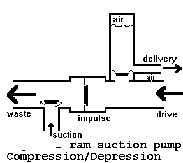
A hydraulic ram pump, sometimes called a hydram, is relatively easy to build, and can drive water up to 100 metres high. Essentially, it’s an automatic pumping device which uses a small fall of water to lift a fraction of the water available to a much greater height using only the power of gravity. Its only moving parts are two valves, and this gives it high reliability, minimal maintenance requirements and a long operational life. Its an ‘old-tech’ device that is as useful today as ever. Invented before electric water pumps, this rugged, simple and reliable device is typically installed at remote home sites for domestic water supply, watering livestock, gardens, decorative lily and fish ponds, water wheels and fountains. Because it uses no power, a ram pump can be used where water would normally not be used and would flow on downstream.
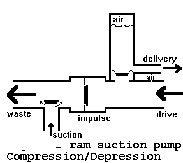
Your DIY shopping list:
T-joint brass 3/4 inch inside thread
Brass reducing coupling 1 inch to 3/4 inch outside thread
Foot valve brass 1 inch inside thread (ball shape and used in reverse direction)
O-ring nitrilrubber 6.0 mm x 1.5 mm (to regulate pump frequency)
Brass reducing coupling 1 inch to 3/4 inch outside thread
Spring-loaded check valve brass 1 inch inside thread “EUROPA”
(optional) brass quick-connect coupling “GEKA” 1 inch outside thread
(optional) Hose quick-connect brass coupling “GEKA” 1 1/4 inch
may be replaced by brass converter from 1 inch thread to 1 1/4 inch hose coupling.
Pressure tube TRICOFLEX 1 1/4 inch x 150 cm (more than 10 bar)
Hose clamp “JUBILEE” stainless steel 30-40 mm
Hose quick-connect brass coupling “GEKA” 1 1/4 inch
Hose clamp “JUBILEE” stainless steel 30-40 mm
Hose quick-connect brass coupling “GEKA” 1/2 inch
Enflontape 12 mm x 0.1 mm or fibre “WURTH” (like for central heating installations)