
UK Chancellor Rachel Reeves is preparing for a TV round this morning to reassure us there is no fuel shortage. Its like when a stranger knocks on your front door and says”Don’t worry” and you know you should be very very worried.
-
THE REALITY: We were all looking forward to that 7% Price Cap drop in April. It was the one glimmer of hope in a bleak fiscal year. That hope is now under extreme threat.
-
THE RESULT: If US supply is cut, the government won’t let your radiators go cold (that’s PR suicide), but they will make you pay for the privilege. Expect “Emergency Energy Levies” to be slapped onto bills by summer. We’ll be forced to outbid Asia for the few remaining Qatari tankers that are brave enough to dodge the chaos in the Strait of Hormuz. It’s essentially a global auction where the prize is “not freezing.”
This is where the “stiff upper lip” starts to tremble. Unlike homes, industry is the national “buffer.” In the energy world, “buffer” is just a polite term for “the first people we throw overboard.”
-
DEMAND SIDE RESPONSE: If you’re running a high-intensity site—chemicals, glass, steel—get ready for the “Load Shedding” requests. It sounds like a trendy new minimalist lifestyle, but it actually means your local grid operator calling to ask if you’d mind turning off the factory for a bit.
-
THE COST OF STEAM: For gas-intensive manufacturing, the “marginal molecule” of gas will likely cost 3-4x the 2025 average. We are reaching a point where the math simply stops working. Many sites will find it cheaper to break their supply contracts and halt production entirely than to keep the furnaces running. When it’s more profitable not to make things, you know the system is in a fever dream.
We are currently staring down the barrel of the “Late April Chill.” It’s a classic British tradition: the moment you think it’s safe to put the duvet away, the Arctic sends us a parting gift.
THE BOTTOM LINE
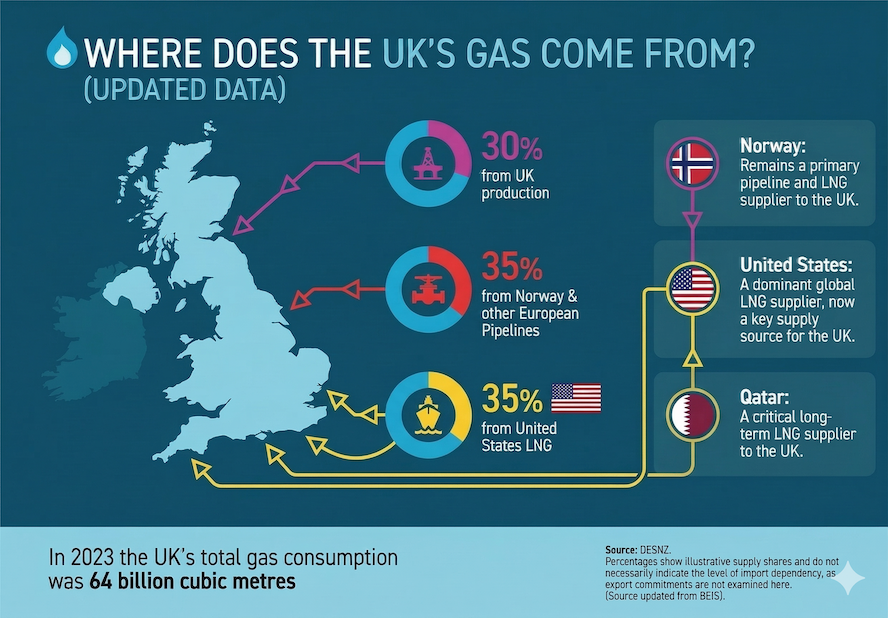
This isn’t 2022. We don’t have the same reserves, and we don’t have the same friends. The reliance we built on US LNG has become our greatest strategic vulnerability.