
Here’s the Post’s guide to the top climate-friendly benefits of the Inflation Reduction Act, and how to access them.

“Greenflation” will be the word of the year by late 2023.
In 2022, the US Congress passed the biggest climate bill in history — under the name the “Inflation Reduction Act.” It calls for a 10-year torrent of money to be spent on installing heat pumps, solar panels and other clean energy equipment in American households and businesses.
Starting today, the Act will offer households thousands of dollars to transition over from fossil-fuel burning heaters, stoves and cars to cleaner versions. Middle-class families will be able to access tax credits for solar, electric stoves, cars, and other kinds of renewable energy equipment. By mid-2023, lower-income households will get discounts without having to wait to file their taxes to get the cash back. This online tool shows what you might be eligible for, depending on your Zip code and income.
According to Washington Post journalist Shannon Osaka the new US Inflation Reduction Act provides multiple ways to green the economy and save money. But the money saved per household will be depend on future energy prices, and the effect on carbon emissions will be relatively slight, unless the growth in clean energy is accompanied by a sharp overall reduction in energy consumption.
Up to a billion separate items of home and office equipment will need to be swapped out – from fridges and heaters to aircon units and cars. Who will manufacture all these wonderful new products? And who will install and maintain them? There is already a shortage of both labor and materials.
Economists say the IRA may not reduce inflation very much, but they don’t say it could spur inflation in the sectors affected by the new law. As millions of households across America switch to cleaner energy sources with the help of government money (meaning our money), there will be shortages of both skilled labor and of equipment, driving up prices.
There are currently only about 13,000 solar installation companies across the USA, growing at an average of 2.5% per year. And the number of workers employed as solar or wind energy installers is projected to grow by less than 10,500 between now and 2029, according to US government figures.
The growth rate of all occupations in the U.S. is predicted to be 3.7% from 2019 to 2029. Wind turbine service technicians and solar photovoltaic installers, on the other hand, are predicted to grow at a rate of 60.7% and 50.5%, respectively, , from a very low base.
If this prediction is correct, together, these two occupations will add only 10,400 new jobs to the U.S. economy by 2029.
| Quick Facts: Solar Photovoltaic Installers | |
|---|---|
| 2021 Median Pay | $47,670 per year $22.92 per hour |
| Typical Entry-Level Education | High school diploma or equivalent |
| Work Experience in a Related Occupation | None |
| On-the-job Training | Moderate-term on-the-job training |
| Number of Jobs, 2021 | 17,100 |
| Job Outlook, 2021-31 | 27% (Much faster than average) |
| Employment Change, 2021-31 | 4,600 |
(Source: US Bureau of Labor Statistics)
So-called solutions may even turn out to be counter-productive as they seek to pretend that the major changes needed can be achieved without much sacrifice or economic pain.
Heat pumps — the best choice for decarbonizing at home if you have a high level of insulation – they require about 35% of the energy of current appliances to do the same job
Tax credit available on Jan. 1: 30 percent of the cost, up to $2,000
Income limit: None
These appliances run on electricity and move heat, instead of creating it, and so can be more efficient than traditional gas or electrical resistance heaters.
According to one analysis using data from the National Renewable Energy Laboratory, switching to a heat pump can save homeowners anywhere from $100 to $1,200 per year on heating bills and prevent anywhere from 1 to 8 metric tons of carbon dioxide emissions per year. For comparison, going vegan for an entire year saves about 1 metric ton of CO2 emissions.
Electric vehicles — top choice for cutting car emissions
Tax credit available on Jan. 1: Up to $7,500 depending on the make and model of the car
Income limit: <$150,000 for single filers; <$300,000 for joint filers
Starting Jan. 1, a new EV tax credit will offer consumers up to $7,500 off the purchase of an electric vehicle. For the first few months, Americans will get somewhere between $3,751 and $7,500 off their purchase of an EV, depending on the size of the battery in the car.
There are limitations, per the new law. The vehicles will also have to be assembled in North America, and cars that cost more than $55,000 aren’t eligible, nor are vans or trucks that cost more than $80,000. This week, the Internal Revenue Service provided a list of vehicles that are expected to meet the criteria starting Jan. 1.
Beginning about March, however, that $7,500 credit will be split into two parts: Consumers can get a $3,750 credit if the vehicle has a battery containing at least 40 percent critical minerals from the United States (or a country that the United States has a free-trade agreement with) and another $3,750 credit if at least 50 percent of the battery’s components were assembled and manufactured in North America. Those rules haven’t been finalized yet, so the tax credit starting on Jan. 1 is a stopgap measure until the White House has ironed out the final version.
Rooftop solar — the best choice for generating clean energy
Tax credit available now: 30 percent of the cost of installation, no cap
Income limit: None
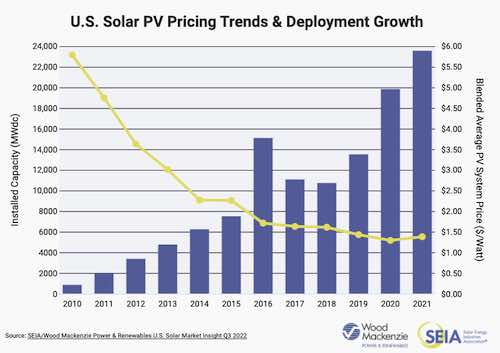
For those who want to generate their own clean energy, there is always rooftop solar panels. This tax credit has actually been available since the Inflation Reduction Act was signed into law in August 2022. It offers a tax credit equal to 30 percent of the cost of installing rooftop solar, with no cap. According to Rewiring America, the average 6 kilowatt solar installation costs about $19,000, making the average solar tax credit about $5,700. (The Inflation Reduction Act also includes a 30 percent tax credit for homeowners that need to upgrade their electricity panel for rooftop solar, and a 30 percent tax credit for installing battery storage.)
For people who don’t own their own homes, there are other options as well. Renters can subscribe to a community solar project to lower their electricity bills and get indirect benefits from the tax credits.
There are many other credits also coming out in 2023: for EV chargers (up to $1,000), heat pump water heaters (up to $2,000), and even cash for sealing up the doors and windows of your home (up to $1,200).